Left-Wing Extremism (LWE) refers to violent movements that seek to overthrow the existing political and economic system through armed struggle. In India, LWE is primarily associated with Maoist or Naxalite insurgency.
The term Naxalism originated from the Naxalbari uprising of 1967 in West Bengal. Over time, the movement spread to parts of central and eastern India, particularly areas with significant tribal populations, forest cover and histories of socioeconomic deprivation.
Evolution of Left-Wing Extremism in India
Naxalism in India evolved from a peasant uprising in 1967 into a long-running Maoist armed movement.
Phase 1: Origins(1967-1974)
The movement began at Naxalbari in Darjeeling, West Bengal, where tribal peasants and landless workers rose against landlords over land rights. It took its name from this village.
- Radical leaders such as Charu Majumdar and Kanu Sanyal broke from CPI(M) after rejecting elections and parliamentary politics.
- In 1969, they formed the CPI (Marxist–Leninist), inspired by Mao Zedong’s idea of a “protracted people’s war.”
- The movement spread to parts of West Bengal, Andhra Pradesh, Bihar, and other states, but government action and internal splits weakened it by the mid-1970s.
Phase 2: Regrouping (1980s–1990s)
After decline, Naxalism re-emerged in a more organised and violent form, especially in rural and tribal regions.
- The People’s War Group (PWG) became active mainly in Andhra Pradesh, while the Maoist Communist Centre (MCC) grew in Bihar and Jharkhand.
- The movement expanded into Chhattisgarh, Odisha, Maharashtra, and other forested, mineral-rich areas.
Phase 3: CPI (Maoist)(2004 onwards)
The biggest turning point came in September 2004, when the PWG and MCC merged to form the Communist Party of India (Maoist), or CPI (Maoist).
- Its armed wing, the People’s Liberation Guerrilla Army (PLGA), carried out more coordinated attacks on police, security forces, and infrastructure.
- The movement became India’s major Left Wing Extremist (LWE) challenge, especially across the “Red Corridor” in central and eastern India.
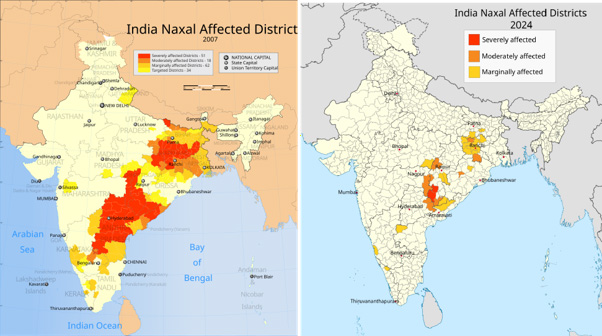
Current status: 2026
According to a Ministry of Home Affairs statement reported in July 2026, no district is currently categorised as LWE-affected. The number of affected districts fell from 126 in 2014 to eight in December 2025 to almost zero in March 2026. However, 37 districts remain classified as Legacy and Thrust districts requiring continued attention, and one district is categorised as a District of Concern.
Causes of Left-Wing Extremism
There is not a single factor but interaction among multiple factors which led to rise and growth of naxalism in India.
A. Socioeconomic causes
1. Land alienation: Dams, mines, forests, and industrial projects displaced many Adivasis without fair compensation or rehabilitation. This created deep resentment against the state and companies
2. Land inequality and landlordism: In the beginning, peasants in Naxalbari protested against landlords and unequal land ownership. Incomplete land reforms left many rural people landless or insecure.
3. Poverty and unemployment: Remote rural and tribal areas had few jobs, poor incomes, and limited livelihood options. This made young people more vulnerable to Naxal recruitment.
4. Loss of forest and land rights: Tribal communities depended on forests for food, fuel, and livelihood. Restrictions on forest use, weak implementation of forest-rights laws, and loss of access to land increased alienation.
B. Political and administrative causes
5. Governance deficit: In many forested villages, there were few schools, hospitals, roads, police stations, or courts. Naxals filled this vacuum by settling disputes and creating a parallel administration.
6. Weak implementation of tribal protections: Laws meant to protect tribal self-rule and forest rights, such as PESA and the Forest Rights Act, were often poorly enforced .
7. Poor access to justice: Delays, high costs, and unfair treatment in the legal system pushed marginalised people towards Naxal “people’s courts” and armed groups.
8. Corruption and exploitation: Corruption in welfare schemes, exploitation by contractors and officials, and denial of basic services reduced people’s trust in government.
C. Social and ideological causes
9. Caste and tribal discrimination: Dalits and Adivasis faced social exclusion, economic exploitation, and political marginalisation. This made Maoist promises of equality attractive.
10. Maoist ideology: Naxal leaders used Marxist–Maoist ideas to present armed struggle as the only way to end exploitation and achieve “land, forest, and water” rights
Major characteristics of LWE
- Revolutionary ideology: Seeks to replace the existing political order through armed revolution.
- Guerrilla warfare: Historically relies on ambushes, surprise attacks and small-unit operations.
- Exploitation of local grievances: Uses land disputes, displacement, inequality and distrust of administration for mobilisation.
- Parallel authority: Attempts to impose informal courts, illegal levies and coercive control in some areas.
- Targeting of infrastructure: Has attacked roads, railways, communication facilities and development projects.
- Recruitment and propaganda: Uses ideological messaging, coercion and local networks to sustain organisational influence.
Impact of Left-Wing Extremism
- Internal security: Attacks on police, paramilitary personnel and civilians undermine public safety, increase security expenditure and weaken the state's ability to maintain law and order.
- Economic development: Threats to contractors, extortion and attacks on infrastructure delay roads, schools, telecommunications and other public projects. Insecurity can also discourage private investment and employment generation.
- Human development : Violence and insecurity disrupt education, healthcare, welfare delivery and access to markets. Children and vulnerable communities are particularly affected.
- Governance and democracy :Coercive parallel authority weakens elected local institutions, restricts freedom of expression and undermines participatory governance.
- Administrative Paralysis: In peak operational zones, regular civil administration often collapsed, leaving public welfare distribution networks (like food and medical supplies) highly dysfunctional or entirely absent
Government measures to tackle LWE
The National Policy and Action Plan to address Left-Wing Extremism (LWE) was approved by the Government of India in 2015. The government follows a multi-pronged approach combining security measures, accelerated development, and the protection of local rights and entitlements.
A. Security and Operational Measures
1. Deployment of Central Armed Police Forces (CAPFs) and specialised forces: such as CoBRA (specialized unit of the Central Reserve Police Force (CRPF)), Greyhounds (anti-Naxal and specialized commando force originally raised by Andhra Pradesh).
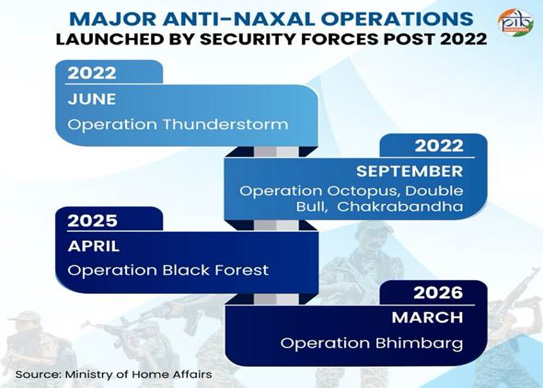
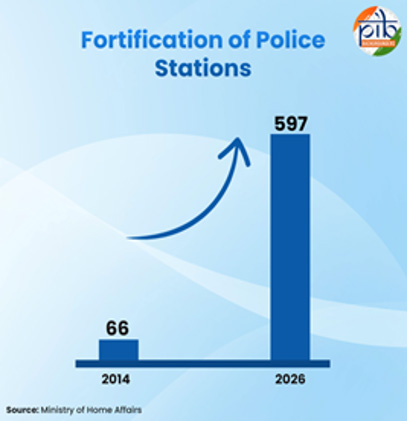
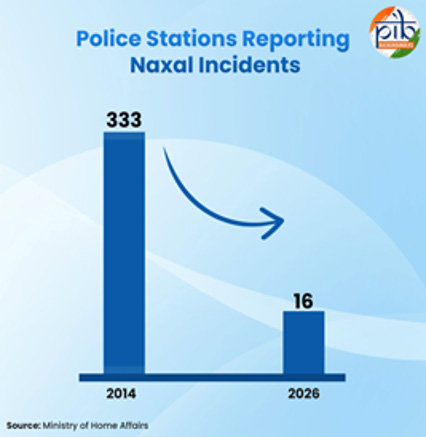
2. Strengthening state police: through Special Infrastructure Scheme (to strengthen state special forces and the construction of fortified police stations ) , Security Related Expenditure (Reimburses to state governments ) Scheme,Special Central Assistance (Provides crucial funding to bridge critical gaps in public infrastructure and development ) Scheme.
B. Development-related measures
- Road connectivity: The Road Requirement Plan and Road Connectivity Project for LWE Areas have supported connectivity in previously affected regions.
- Telecommunications: Mobile towers and improved digital connectivity help connect remote settlements with public services and markets.(Mobile Connectivity Project)
- Education and healthcare: Better access to schools, hostels, health facilities and essential services can reduce long-standing governance gaps. Example: Eklavya Model Residential Schools (EMRS), Expands quality residential education for tribal youth in interior districts
- Livelihood generation: Skill development, employment opportunities, financial inclusion and local enterprise can reduce economic vulnerability.
- Welfare delivery: Effective implementation of food security, housing, pensions and other schemes strengthens citizens' trust in public institutions. Example: Aspirational Districts Programme and PM-JANMAN
C. Rights and governance measures
- Forest Rights Act, 2006: Effective implementation of the Scheduled Tribes and Other Traditional Forest Dwellers (Recognition of Forest Rights) Act, 2006, helps eligible communities secure recognised individual and community forest rights.
- PESA, 1996 : The Panchayats (Extension to Scheduled Areas) Act, 1996, provides for a greater role for Gram Sabhas and Panchayats in Scheduled Areas, subject to the Act's provisions and applicable state laws.
D. Surrender and rehabilitation
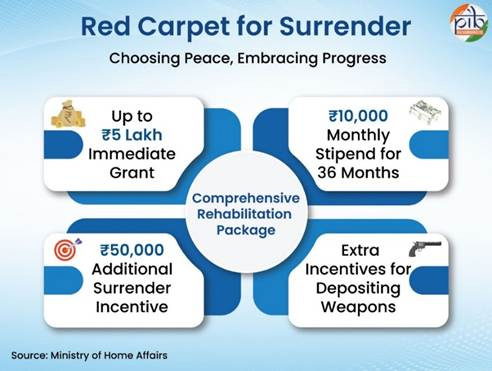
Surrender-cum-Rehabilitation Policy under the Security Related Expenditure (SRE) Scheme aims to help insurgents give up violence and rejoin mainstream society.
SAMADHAN strategy The SAMADHAN strategy is an integrated operational doctrine introduced by India's Union Ministry of Home Affairs to combat Left-Wing Extremism - S – Smart Leadership
- A – Aggressive Strategy
- M – Motivation and Training
- A – Actionable Intelligence
- D – Dashboard-based Key Performance Indicators and Key Result Areas
- H – Harnessing Technology
- A – Action Plan for Each Theatre
- N – No Access to Financing
Key data points: - LWE violence related incidents dropped from 1936 in 2010 to 234 in 2025, approximately 88% decline.
- LWE related death cases dropped from 1005 in 2010 to 100 in 2025, approximately 90% decline.
|
Naxal Mukt Bharat
India achieved effective freedom from Left-Wing Extremism (LWE) on March 31, 2026, meeting the government's self-imposed target for a Naxal-Mukt Bharat. The achievement marks a significant milestone in India's efforts to combat Left-Wing Extremism.
Key highlights:
- Districts Affected: Dropped sharply from 126 districts in 2014 down to essentially 0–2 localized zones by early 2026.
- Surrenders & Arrests: A total of 3,927 Naxal cadres surrendered between 2024 and March 2026.
- Neutralisation of top leadership, under the "Trace, Target, Neutralise" operational framework.
Naxal-Mukt Bharat 2026 marks an important milestone in India's stated effort to eliminate Left-Wing Extremism. However, lasting success will depend on consolidating security gains through inclusive development, protection of tribal rights, responsive governance and community participation.