The universe is everything.The observable universe has billions of galaxies. Each galaxy has many stars, planets, gas, and dust. But ordinary matter is only a small part of everything in the universe. Most of the universe is made of two invisible things: dark matter and dark energy. So the universe is much more complex to define in simple words.
It even includes time itself and, of course, it includes you. Let's try to analyse the universe and its formation in detail.
Big Bang Theory
The Big Bang Theory provided the most significant and explanatory scientific model for the origin of the universe.The term “Big Bang” was coined by Fred Hoyle.
Major postulates of the theory:
- It states that the universe started as a tiny, hot, and dense point.
- Approximately 13.8 billion years ago, right after the Big Bang, the universe was extremely hot and crowded with tiny particles like protons and neutrons.
- After about 1 to 3 minutes, it became cool enough for these protons and neutrons to stick together and form the first atomic nuclei.
- Over time, matter accumulated under gravity, forming large gas clouds that eventually gave rise to the first stars.
- Stars subsequently became organised into galaxies.
Major Evidence Supporting the Big Bang Theory
- The first major evidence is the expansion of the universe : Edwin Hubble discovered in the 1920s that distant galaxies are moving away from us.Running this expansion backward implies the universe originated from a single, dense point. This was further explained by the redshift of the light emitted by these galaxies.
| A redshift is an increase in the wavelength and a corresponding decrease in the frequency and energy of electromagnetic radiation, such as light, making it shift toward the red end of the spectrum. |
- Cosmic Microwave Background Radiation: leftover thermal heat from the Big Bang that fills the entire universe. The CMB is the strongest proof we have for the Big Bang Theory.
Limitations
Although the big bang theory is comprehensive enough to explain the formation and evolution of the universe, few mysteries of the universe remain unsolved.
For instance
- It does not explain what caused the initial expansion.
- why matter dominates over antimatter.
- Similarly, the precise nature of dark matter and dark energy remains uncertain.
Higgs Boson
The Higgs boson is a fundamental particle associated with the Higgs field. According to the Standard Model of particle physics, interaction with this field gives mass to many fundamental particles.
It was theoretically proposed in 1964, independently by Peter Higgs. Its existence was experimentally confirmed in 2012 at CERN's Large Hadron Collider (LHC).
What is the Higgs Field?
The Higgs field is an invisible field that exists throughout space. Fundamental particles interact with this field to different degrees.
- A particle interacting weakly with the Higgs field moves relatively easily and attains lower mass.
- A particle interacting strongly with the field experiences greater resistance and higher mass.
CERN's Large Hadron Collider (LHC). The LHC accelerates protons to extremely high energies and collides them. These collisions briefly create extreme conditions in which rare particles can be produced. |
Galaxies
A galaxy consists of stars, gas, dust, stellar remnants, planets and dark matter bounded by gravitational force.
Galaxies originated from small density fluctuations in the early universe. After the Big Bang, matter was not distributed perfectly uniformly. Slightly denser regions exerted stronger gravitational attraction and gradually accumulated more matter
Example: The Milky Way and Andromeda Galaxy (M31).
Types of Galaxies
A. Spiral Galaxies: have a flattened rotating disk, a central bulge and prominent spiral arms. The spiral arms contain large amounts of gas and dust and are active regions of star formation.
Example: The Milky Way.
B. Elliptical Galaxies: range from nearly spherical to highly elongated shapes. They generally contain older stars, relatively little cold gas and dust, and comparatively low rates of new star formation.
Example: Messier 87 (M87)
C. Irregular Galaxies: lack a well-defined shape, like spiral or elliptical structure.
Examples: Large Magellanic Cloud (LMC).
D. Lenticular Galaxies: These galaxies have a prominent central bulge and a disk but lack the prominent spiral arms of spiral galaxies. They generally contain less gas and dust and have relatively low rates of star formation.
Example: Sombrero Galaxy (M104).
Stars
A star is a luminous spheroid of plasma held together by self-gravity. Stars shine because of nuclear fusion in their hot cores. This fusion turns hydrogen into helium and releases heat and light.The energy produced by nuclear fusion is transported from the stellar interior toward the surface and is ultimately radiated into space as electromagnetic radiation.
A star's mass is one of the most important factors determining its evolution, lifetime and ultimate fate.
The Sun is the nearest star to Earth and provides the energy necessary for life.
Life cycle of a star :
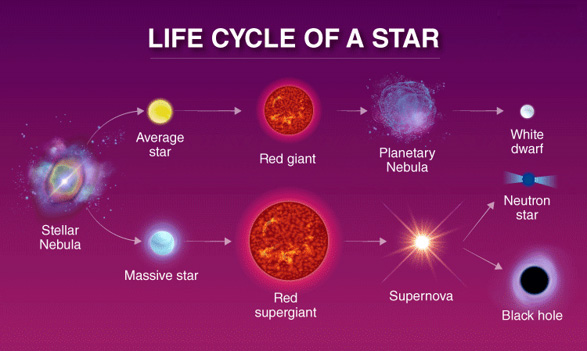
Birth :Nebula and Protostar
- Stars originate mainly within cold, dense molecular clouds of gas and dust known as stellar nurseries.
- Under the gravitational collapse due to a trigger—such as a shockwave from a nearby supernova or a cloud collision , the central mass transforms into the protostar.
- When the core temperature reaches millions of degrees, hydrogen atoms begin fusing into helium, releasing massive amounts of energy and light to officially create a main-sequence star
Maturity: The Main Sequence
- Nuclear Fusion: When the core gets hot enough, hydrogen atoms fuse into helium. This releases huge amounts of energy.
- Balance: The outward push from nuclear energy balances the inward pull of gravity. This stable stage is called the main sequence.
- Lifespan: Smaller stars burn fuel slowly and last for billions of years. Massive stars burn fuel quickly and live much shorter lives.
Aging and Death:
Average Stars
- Red Giant: When hydrogen runs out, the core shrinks and the outer layers expand and cool, turning red.
- Planetary Nebula: The outer layers drift away into space, creating a glowing shell of gas.
- White Dwarf: The leftover hot, dense core remains as a white dwarf, which eventually cools into a dead black dwarf.
Massive Stars
- Red Supergiant: Massive stars expand into much larger red supergiants and fuse heavier elements until they hit iron.
- Supernova: Without fuel, the core collapses instantly and triggers a giant explosion called a supernova.
- Neutron Star or Black Hole: The leftover core becomes an ultra-dense neutron star or a deep black hole.
The Solar System
The Solar System is a gravitationally bound system consisting of the Sun, eight planets, dwarf planets, moons, asteroids, comets, meteoroids, dust and other small bodies. The Solar System lies approximately 26,000–27,000 light-years from the Galactic Centre, within the Orion Arm of the Milky Way.
Origin of the Solar System
Based on the idea of Nebular Hypothesis, the Solar System formed about 4.6 billion years ago from a rotating cloud of gas and dust.
Sequence of formation:
- A giant molecular cloud or nebula collapsed under gravity, triggered by a supernova.
- Rotating solar nebula flattened into the protoplanetary disk.
- Central mass forms into proto-sun.
- Localised masses form into planetesimals and proto-planets.
- Later developed into planets and other bodies.
The Sun
The Sun is a main-sequence star and the central body of the Solar System. It provides almost all of the energy driving Earth's climate system, atmospheric circulations, hydrological cycle, and photosynthesis. Energy is generated mainly through nuclear fusion of hydrogen into helium in its core.
Classification of Planets
The eight planets can broadly be divided into two groups:
A. Terrestrial Planets
- These are mercury, venus, earth, mars.
- These are relatively small, rocky, and dense.
B. Giant Planets
- These are Jupiter, Saturn, Uranus, Neptune.
- They are much larger and have thick gaseous or icy envelopes.
- Giant planets are further divided into gas giants (Jupiter and Saturn) and ice giants (Uranus and Neptune). Uranus and Neptune contain substantial amounts of water, ammonia and methane-rich material beneath their atmospheres and are therefore classified separately from Jupiter and Saturn.
| Planet | Key characteristic |
| Mercury | Closest to Sun; smallest planet |
| Venus | Hottest planetary surface; dense CO₂ atmosphere |
| Earth | surface water; known life |
| Mars | Iron-rich surface; evidence of ancient water |
| Jupiter | Largest planet |
| Saturn | Prominent ring system |
| Uranus | Extreme axial tilt; ice giant |
| Neptune | Most distant major planet |
Small Bodies of the Solar System
- Asteroids: Mostly rocky or metallic bodies, particularly abundant in the asteroid belt between Mars and Jupiter.
- Comets: Bodies rich in volatile ices, dust and rock. When approaching the Sun, heating causes a coma and often a tail.
- Meteoroids: Small rocky or metallic objects travelling through space.
- Dwarf planets: are celestial bodies that orbit the Sun and are massive enough to have become nearly round under their own gravity but have not cleared the neighbourhood around their orbit. Examples include Pluto, Ceres, Eris.
- The Kuiper Belt : is a region beyond Neptune containing numerous icy bodies and dwarf planets.
- Oort Cloud: The Oort Cloud is a huge, invisible shell of icy objects that surrounds our entire solar system. It lies far beyond Pluto and the Kuiper Belt.The Oort Cloud is thought to contain billions or even trillions of small icy bodies left over from the formation of the solar system, and it acts like a giant “comet reservoir” at the outer edge of the Sun’s gravitational influence
Lagrange points
Lagrange points are special positions in a two-body gravitational system where the gravitational forces of the two large bodies, combined with the orbital motion of a smaller object, allow the smaller object to remain in a relatively stable position with respect to the two bodies. There are five Lagrange points — L1, L2, L3, L4 and L5.
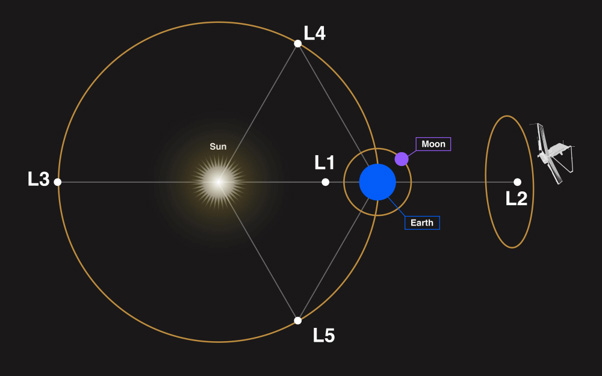
| Lagrange Points | Major application |
| L1 — Between the Two Bodies | - L1 is particularly useful for solar observation because a spacecraft placed there can continuously observe the Sun and obtain early information about solar activity.
- Example : AdityaL1 of India operates near the Sun–Earth L1 region.
|
| L2 — Beyond the Smaller Body | - valuable for space telescopes and astronomy because the spacecraft can remain relatively protected from the Sun, Earth and Moon.
- Example: James Webb Space Telescope
|
| L3 — Opposite Side of the Larger Body | - less useful for spacecraft missions because the Sun lies between the spacecraft and Earth, making communication and direct observation of Earth difficult.
|
| L4 — 60° Ahead | - L4 is a stable Lagrange point under suitable mass-ratio conditions.
- Example :In the Sun–Jupiter system, asteroids occupying L4 and L5 are known as Trojan asteroids.
|
| L5 — 60° Behind | - gravitationally stable under the appropriate mass-ratio condition.
|
Satellites
A satellite is any object, natural like the moon or artificial like a machine launched by a rocket, that moves in a repeating path around a planet or star. The Moon is a satellite orbiting Earth.
Orbit
An orbit is the curved path followed by a celestial body or artificial satellite around another body under the influence of gravity. The Earth orbits the Sun, the Moon orbits Earth, and artificial satellites orbit Earth.
How Does an Orbit Form?
If an object is simply released near Earth, gravity pulls it downward and it falls. But if the object is given sufficient horizontal velocity, it continuously falls toward Earth while the curved Earth’s surface falls away beneath it. Depending on the object's energy and velocity relative to the central body, trajectories can be circular, elliptical, parabolic or hyperbolic.
Artificial Satellite
An artificial satellite is a human-made object sent into space to orbit Earth or another celestial body.
Uses:
- Communication Satellites: Transmit television, phone, and internet signals across long distances globally.
- Weather Satellites: Monitor atmospheric conditions, clouds, and storms to help meteorologists forecast weather and track disasters
- Navigation Satellites: Form global positioning networks like GPS to help people and vehicles pinpoint exact locations on earth.
- Scientific and Research Satellites: Face outward to study distant stars and galaxies or inward to observe Earth's climate, land, and oceans
- Remote Sensing Satellites :Collect information about Earth's surface without direct physical contact and are used in agriculture, forestry, mineral exploration etc.
Moon
The Moon is Earth's only natural satellite and the brightest object in the night sky after the Sun. It takes about 27.3 days to revolve around Earth relative to the stars. It does not produce its own light; it shines by reflecting sunlight.
The Moon is tidally locked to Earth, meaning that its rotation period is approximately equal to its orbital period around Earth. Consequently, nearly the same side of the Moon generally faces Earth.
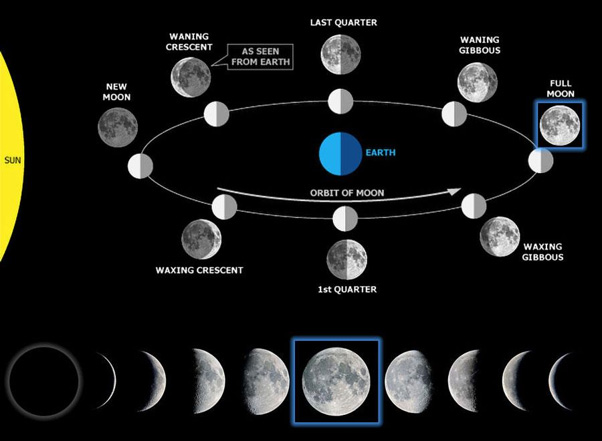
Phases of the Moon:
The phases of the Moon occur because we see different portions of its sunlit half as the Moon revolves around Earth. The major phases are New Moon, First Quarter, Full Moon and Third Quarter.
SUPERMOON
A supermoon occurs when a full Moon or new Moon coincides with the Moon being near its closest approach to Earth (perigee).
BLUE MOON
The second full Moon occurring within the same calendar month is called a Blue Moon.
BLOOD MOON
A Blood Moon is the popular name for a total lunar eclipse when the Moon takes on a reddish or copper colour.
Chandrayaan-1
Chandrayaan-1 was India's first mission to the Moon, launched by ISRO in 2008. It was a landmark mission because it provided strong evidence of water molecules on the lunar surface, especially at high latitudes.
Components:
A.orbiter
B. Moon Impact Probe.
Major Objectives:
A. Mapping the lunar surface
B. Search for water
C. Study of lunar mineralogy.
Achievements:
Chandrayaan-1 provided evidence of water/hydroxyl molecules associated with the lunar surface, including polar regions.
Chandrayaan-2
Chandrayaan-2 was India's second lunar mission, launched by Indian Space Research Organisation (ISRO) on 22 July 2019. It was India's first mission designed to attempt a soft landing and rover operation on the lunar surface.
Three major elements:
- Orbiter : Revolved around the Moon and carried multiple scientific instruments.
- Vikram Lander : Designed to make a controlled soft landing on the lunar surface.
- Pragyan Rover : A small six-wheeled rover designed to travel on the lunar surface and conduct in-situ experiments.
Why the Lunar South Pole?
This region is important because:
- some craters remain permanently shadowed;
- extremely low temperatures can preserve volatile substances;
- water-ice deposits may exist in permanently shadowed regions;
- The region provides a natural laboratory for studying the Moon's geological history.
What happened during landing?
The landing component of Chandrayaan-2 did not achieve a successful soft landing, while the orbiter successfully entered lunar orbit and continued its scientific mission.
Chandrayaan-3
Chandrayaan-3 is India's third lunar mission and the follow-up to Chandrayaan-2. Its central objective was to demonstrate safe and soft landing, rover mobility and in-situ scientific experiments on the lunar surface.
On 23 August 2023, India successfully landed Chandrayaan-3's Vikram lander near the Moon's south-polar region, making India the first country to achieve a soft landing in the Moon's southern high-latitude region.
Chandrayaan-3 consisted of:
A. Propulsion Module : role was to carry the lander from Earth orbit toward the Moon.
B. Vikram Lander : It was responsible for autonomous descent and conducting surface experiments.
C. Pragyan Rover : moved on the lunar surface and carried scientific instruments.
Shiv Shakti Point
The Chandrayaan-3 landing site was named Shiv Shakti Point.The name symbolises India's scientific and technological capability and the mission's lunar achievement.
Significance:
Chandrayaan-3 demonstrated India's capability in precision landing and rover-based lunar surface exploration, strengthening India's technological capacity for future planetary exploration missions.
METEOROID, METEOR & METEORITE
1. Meteoroid
A meteoroid is a relatively small rocky or metallic body travelling through outer space. It may originate from asteroids, comets or debris.
2. Meteor
When a meteoroid enters Earth's atmosphere at high speed, it experiences intense heating and produces a bright streak of light. This visible phenomenon is called a meteor.
Why does it glow?
When a meteoroid enters the atmosphere at high speed, due to compression and heating due to friction from atmospheric gases, it burns and a bright streak is produced called a meteor.
The popular term “shooting star” or “falling star” refers to a meteor, but a meteor is not actually a star.
3. Meteorite
Most small meteoroids completely disintegrate in the atmosphere before reaching Earth's surface. If part of the meteoroid survives its passage through the atmosphere and reaches Earth's surface, the surviving solid fragment is called a meteorite.
Meteorites provide scientists with direct material evidence about the early Solar System because many of them preserve ancient minerals and chemical information from the period of planetary formation.