Our Earth has undergone significant changes since its formation. The early Earth was a hot, unstable and largely inhospitable body, very different from the life-supporting planet we see today. Over the years, differentiation and evolution of life has transformed earth into a habitable platform.
Study of the origin of earth helps us to understand how our planet became a habitable place and how it has evolved from a hot and barren planet to one with lifeforms.
About earth:
- Earth is the third planet from the Sun, and the fifth largest planet
- The equatorial diameter of earth is 7,926 miles (12,756 kilometers).
- Earth is 150 million kilometers away from the Sun.
- It completes one rotation every 23.9 hours.
- It takes 365.25 days to complete one trip around the Sun.
- Earth's axis of rotation is tilted 23.4 degrees with respect to the plane of Earth's orbit around the Sun.
- 71% of Earth's surface is covered by water and about 29% is land.
To understand the origin of the Earth, we need to go back to the origin of the Solar System.
The Solar System and its Origin
The Earth did not form in isolation; it is a part of a larger system known as the Solar System.
The Solar System consists of the Sun, eight planets and numerous smaller bodies that are held together primarily by the Sun's gravitational influence. It formed approximately 4.6 billion years ago. The Solar System is located in the Milky Way Galaxy, in the Orion Arm.
Origin of the Solar System
The Solar System formed approximately 4.6 billion years ago from a collapsing cloud of gas and dust, commonly described as the solar nebula.
Sequence of formation:
- A giant molecular cloud or nebula collapsed under gravity.The precise trigger for the collapse of the solar nebula is not known with certainty.
- One proposed possibility is that a shock wave from a nearby stellar explosion, such as a supernova, may have contributed to triggering the collapse.
- The rotating solar nebula flattened into the protoplanetary disk due to contraction.
- Central mass accumulated matter and eventually formed into proto-sun.
- Within the disk, dust and gas particles collided and gradually accumulated through accretion forming larger bodies called planetesimals.
- Continued accretion and collisions caused planetesimals to grow into protoplanets.
- Later developed into planets and other bodies.
The Sun
The Sun is a main-sequence star and the central body of the Solar System. It provides almost all of the energy driving Earth's climate system, atmospheric circulations, hydrological cycle, and photosynthesis. Energy is generated mainly through nuclear fusion of hydrogen into helium in its core.
Classification of Planets
The eight planets can broadly be divided into two groups:
A. Terrestrial Planets
- These are mercury, venus, earth, mars.
- These are relatively small, rocky, and dense.
- Located in the inner Solar System
B. Giant Planets
- These are Jupiter, Saturn, Uranus, Neptune.
- They are much larger and have thick gaseous or icy envelopes.
- Numerous moons
- Jupiter and Saturn are classified as gas giants, while Uranus and Neptune are classified as ice giants.
| Planet | Key characteristic |
|---|
| Mercury | Closest to Sun; smallest planet; experiences extreme temperature variation |
| Venus | Hottest planetary surface; dense CO₂ atmosphere;rotates very slowly and in the opposite direction to most planets |
| Earth | surface water; known life; Has a nitrogen-oxygen-rich atmosphere; active plate tectonics |
| Mars | Called the Red Planet due to iron oxides; evidence of ancient water |
| Jupiter | Largest planet; powerful magnetic field ; Great Red Spot present on it. |
| Saturn | Prominent ring system; numerous moons, including Titan |
| Uranus | Extreme axial tilt; ice giant ; blue-green colour is associated with methane in its atmosphere |
| Neptune | Most distant major planet; Has very strong winds |
Theories on Origin
There are a number of theories attempted to explain how earth has evolved from primordial matter. Understanding the Earth’s origin helps explain the structure and evolution of landforms, atmosphere, oceans, and biosphere. Earth is part of the solar system, which originated around 4.6 billion years ago. However, scientists in later periods took up the problems of the origin of the universe rather than that of just the earth or the planets.
A. Kant's Nebular Hypothesis
The Nebular Hypothesis was proposed by the German philosopher Immanuel Kant in 1755 to explain the origin and formation of the Solar System. The hypothesis considered that the planets were formed out of a cloud of gas and dust known as a primordial nebula.
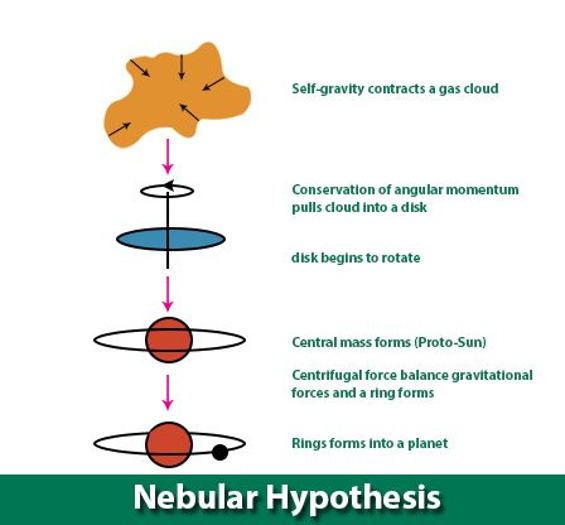
Main propositions of Kant's Nebular Hypothesis
1. Primordial Nebula:
- The solar system originated from a vast, rotating cloud of gas and dust called a nebula.
- The particles in the nebula started moving towards each other, due to gravitational force.
2. Cooling and Condensation:
- This hot gaseous mass cooled over time and began contracting due to gravity.
3. Flattening into a Disk:
- As it contracted, it spun faster due to conservation of angular momentum, flattening into a disc-shaped structure.
4. Formation of Sun:
- The majority of the nebular material accumulated in the central region, resulted in the formation of a dense, hot body.
- As the central region continued to contract, its temperature and pressure increased.
- Eventually, conditions became suitable for nuclear fusion to begin, marking the formation of the Sun as a star.
5. Formation of planets
- The material remaining around the central Sun gradually accumulated into smaller bodies.
- The small particles collided together to form larger aggregates.
- These aggregates gradually developed into planetesimals, which could further combine through accretion to form planetesimals.
- These planetesimals further combine through accretion to form protoplanets.
- Over time, these protoplanets evolved into the planets of the Solar System.
Significance
- First practical explanation of formation of the solar system without divine and supernatural interpretation.
- Emphasized rotation, gravity, and cooling processes.
- Laid the foundation for modern theories of planetary system formation.
Criticisms
- Lacked observational evidence at the time – telescopes and astronomical observations were not advanced enough to provide direct evidence of protoplanetary disc.
- The hypothesis did not provide an explanation of how material could accumulate into distinct planets or how these bodies could grow and maintain stable orbits.
Did not explain:
- The distribution of angular momentum (Sun has most of the mass but planets have most of the angular momentum).
- Variations in planetary composition (terrestrial vs gas giants).
- Why does central material develop into a star and surrounding materials into the planets?
B. Tidal Hypothesis – Jeans and Jeffrey (1919)
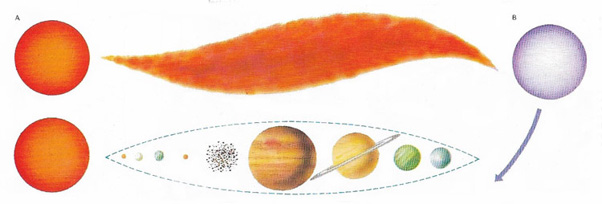
The Tidal Hypothesis, proposed by British scientists James Jeans and Harold Jeffreys, was an alternative to the earlier nebular hypothesis. It assumes that with the sun there was another intruding star in the universe.It suggested that the planets were formed from material drawn out of the primitive Sun due to the gravitational influence of a passing star.
Main Propositions:
1. Presence of a primitive Sun
According to the hypothesis, the Sun existed before the planets were formed. The planets did not form simultaneously with the Sun from a common rotating nebula, as proposed in nebular theories.
2. Close approach of another star
A massive intruding star passed close to the Sun. This gravitational interaction produced strong tidal forces on the solar material.
3. Ejection of solar material
Tidal forces ejected extremely hot gaseous material from the sun.
4. Cooling and condensation
The material gradually lost its heat and later cooled to condense.
5. Formation of planets
The larger condensed masses developed into planets. Smaller fragments could have contributed to the formation of satellites and other smaller bodies.
Significance
- It provided an alternative to the Nebular Hypothesis.
- It focused on the importance of gravitational interactions between stars.
Limitations and Criticism
- A close encounter between two stars is a very rare phenomena.
- The material ejected would have been extremely hot, it must have dispersed into the space rather than cooling and condensing.
- This hypothesis also does not explain the variations in planetary composition (terrestrial vs gas giants).
- It is also unable to explain the distribution of angular momentum (Sun has most of the mass but planets have most of the angular momentum).
- There is no direct astronomical evidence that the Solar System formed through such a close stellar encounter.
C. Planetesimal Hypothesis
The Planetesimal Hypothesis was developed by Thomas C. Chamberlin and Forest R. Moulton in the early 20th century as an alternative to the classical nebular hypothesis. It explained the formation of planets through the gradual accumulation of small solid bodies called planetesimals.
the hypothesis combined two important ideas:
- Stellar encounter as the mechanism that generated the planetary material. (explained in tidal hypothesis)
- Planetesimal accretion through which planets developed through collision and accretion.
Main Propositions:
1. Presence of a primitive Sun
According to the hypothesis, the Sun existed before the planets were formed. The planets did not form simultaneously with the Sun from a common rotating nebula, as proposed in nebular theories.
2. Close Stellar Encounter
A massive intruding star passed close to the Sun. This gravitational interaction produced strong tidal forces on the solar material. This gravitational interaction pulled out filaments of solar material from the Sun.
3. Condensation of Material
The ejected material cooled and condensed into numerous small solid bodies called planetesimals.
4. Accretion Process
These planetesimals began to collide and coalesce through gravitational attraction, forming larger planetary bodies over time.
5. Formation of Planets:
Gradual accumulation of planetesimals led to the formation of planets, moons, asteroids, and other bodies.
Significance
- Introduced the idea of accretion and aggregation as central to planetary formation.
- Recognized the importance of solid matter (rather than gas) in forming planets.
Criticisms
- Highly improbable scenario – close approach of another star is extremely rare.
- Ejected material would likely disperse instead of condensing due to high temperature and low density.
- The angular momentum problem remains unresolved.
- Rejected by modern science, but it influenced later accretion-based models.
Modern Nebular Hypothesis / Accretion Theory by Otto Schmidt,1944.
The Modern Nebular Hypothesis (also known as the Accretion Theory) is the contemporary version of the earlier nebular hypotheses by Kant and Laplace, updated with knowledge from astrophysics, space missions, and computer simulations. It explains the origin and evolution of the Solar System.
Stages of Accretion Theory
1. Formation of Solar Nebula
- The Solar System originated approximately 4.6 billion years ago from a region of a larger molecular cloud.
- This giant molecular cloud (mostly hydrogen and helium) began to collapse under gravity.
- The exact trigger for the collapse is not established with certainty. But possible triggers could be supernova shockwaves or density waves in a spiral galaxy.
2. Formation of Protoplanetary Disk
- This hot gaseous mass cooled over time and began contracting due to gravity.
- As it contracted, it spun faster due to conservation of angular momentum, flattening into a disc-shaped structure.
As the protoplanetary disk cooled, different substances condensed at different temperatures.
1. Inner region : temperatures were very high closer to the sun, therefore only material with high condensation temperature like silicates, iron could remain solid.
2. Outer region: temperature was much lower away from the sun, substances like water, methane and ammonia could condense.
- This temperature gradient helps explain the broad difference between the terrestrial planets and the outer giant planets.
3. Accretion of Planetesimals
- Dust particles collided and stuck together via electrostatic forces and collisions, forming planetesimals.
- Planetesimals further accreted into protoplanets due to gravitational attraction.
4. Formation of Planets
- Inner planets (Mercury–Mars): formed from rocky material (high temp, volatile materials evaporated).
- Outer planets (Jupiter–Neptune): gas giants and ice giants formed where it was cool enough for ice and gases to condense.
- These planets cleared their orbits over millions of years.
Not all planetesimals became planets. Some remained as smaller bodies. The asteroid belt between Mars and Jupiter contains remnants of the early Solar System that did not successfully form a planet. Jupiter’s strong gravitational influences played an important role in preventing these materials from forming a planet.
Significance of Modern Nebular Hypothesis
- Explains variation in terrestrial and giant planet composition and formation.
- Forms the basis of modern planetary science.
Limitations of Modern Nebular Hypothesis
- The exact mechanism of dust to planetesimal growth remains debated.
- Earth's Moon requires an additional impact explanation.