Earth is constantly moving at its own axis from west to east, at the same time around the sun along its orbit. Earth's two principal motions are rotation and revolution. This motion of the earth is responsible for diurnal and seasonal variations on earth.
These motions of earth, along with the inclination of Earth's axis, explain major phenomena such as day and night, seasons, variation in length of day and night, solstices, equinoxes and the apparent movement of the Sun.
Reasons behind the motion:
- Initial spin from around 4.6bn years ago.
- Inertia: Space has almost no friction or air resistance. Because of inertia (an object's resistance to changes in motion), the Earth keeps spinning and orbiting without stopping.
- Gravity: The Sun's massive gravity pulls on the Earth, keeping it trapped in an orbital path.
Rotation
Rotation is the spinning of the Earth on its own axis, due to initial spin, inertia and gravity of the Sun.
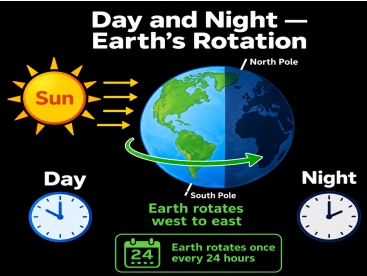
- Earth rotates from west to east and takes about 24 hours to complete one rotation.
- This motion causes day and night.
- Because Earth rotates from west to east, the Sun and stars appear to move across the sky from east to west.
- The 24-hour period refers approximately to the solar day. Relative to distant stars, Earth completes one rotation in about 23 hours 56 minutes.
- The circle of illumination that divides the day and night on the globe is called the circle of illumination.
- Earth rotates on a tilted axis- Earth’s rotational axis makes an angle of 23.5° with the normal.
- Earth's rotation also produces the Coriolis effect, which causes moving air and ocean currents to be deflected:
- to the right in the Northern Hemisphere
- to the left in the Southern Hemisphere
The Coriolis effect describes the pattern of deflection taken by objects not firmly connected to the ground as they travel long distances around the Earth. It is not a physical push or pull.The effect is strongest at the poles and drops to zero right at the equator. Faster-moving objects and winds experience a greater degree of deflection. 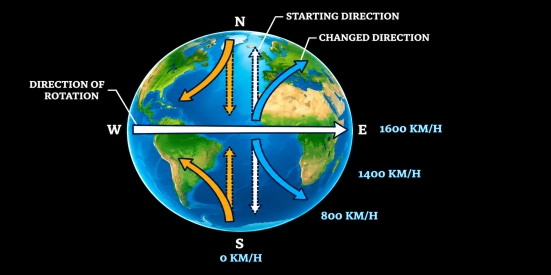 |
Why the Spin Never Stops
There are many reasons behind it.
- Inertia: Inertia is a rule of physics that says a moving object keeps moving unless a force stops it.
- Empty Space: Space is a vacuum with almost no air or friction to slow the Earth down.
- Perpetual Motion: Because no major outside force pushes against it to stop the rotation, Earth just keeps spinning day after day.
Revolution
Revolution is the movement of the Earth around the Sun along its orbit. Earth revolves around the sun because the Sun's massive gravity pulls on the Earth, while the Earth's forward speed keeps it moving around the Sun instead of falling straight in.
Key features :
- Earth takes about 365 1⁄4 days to complete one revolution.
- The Earth's orbit around the Sun is elliptical, with the Sun located at one of the two foci of the ellipse.
- 6 hours saved every year are added to make one day, which is added to the month of February.
- Together with the tilt of Earth’s axis (about 23.5°), revolution causes the seasons.
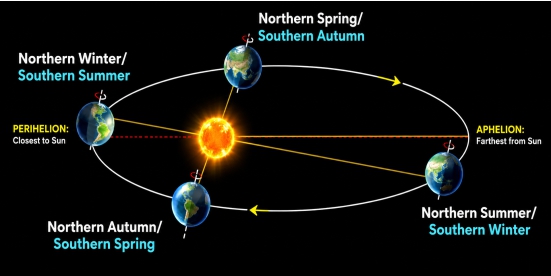
Perihelion
It is the position of the earth on its orbit around the sun. Because the earth moves in an elliptical orbit around the sun the distance between the sun and earth does not remain the same .
- The perihelion is the point in earth’s orbit where Earth is nearest to the sun.
- Earth is about 91.4 million miles (147 million km) away from the sun.
- It happens in early January.
- It has a mild impact on the climate of the earth. The summers in the southern hemisphere became 7% more intense and winters in the northern hemisphere became 7% less harsher.
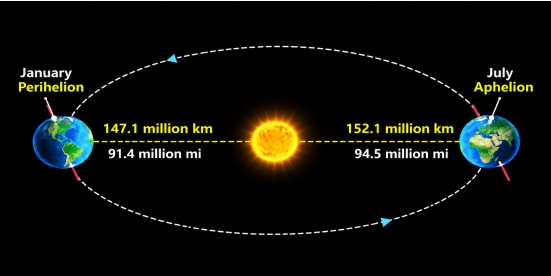
Aphelion
It is the position of the earth on its orbit around the sun. Because the earth moves in an elliptical orbit around the sun the distance between the sun and earth does not remain the same.
- The point where Earth is farthest from the sun.
- Earth is about 94.5 million miles (152 million km) away from the sun.
- It happens in early July.
- It again has a mild impact on the climate of earth. The summers in the northern hemisphere became 7% less intense and winters in the southern hemisphere became 7% more harsher.
Change of Seasons
Seasons change due to Earth's axial tilt combined with its revolution of the earth around the sun, marked by change in weather, temperature, precipitation and daylight.
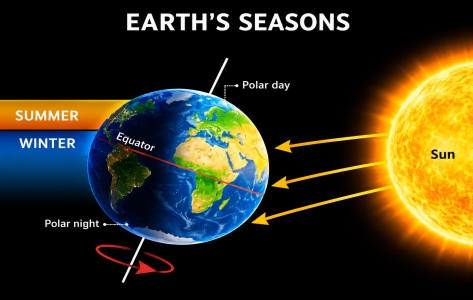
The Northern and Southern Hemispheres experience opposite seasons. When the Northern Hemisphere is tilted towards the Sun, it experiences summer while the Southern Hemisphere experiences winter.
- The Equator experiences relatively little seasonal temperature variation because it receives relatively direct solar radiation throughout the year.
- The polar regions experience extreme seasonal variation in daylight.
The Four Seasons:
- Summer : summer season is the hottest season with the longest days and active plant growth. Falls between spring and autumn.
Cause - This season happens because the Earth tilts toward the sun, giving that half of the planet more direct sunlight and longer daylight hours.
- Winter :is the coldest season featuring short days, freezing temperatures, and dormancy or snow in many temperate regions. It falls between autumn and spring.
Cause - This season happens because the Earth tilts away the sun, giving that half of the planet slanted sunlight and shorter daylight hours.
- Autumn: marks the transition to cooler weather, with leaves changing color, crops being harvested, and days getting shorter. Earth's tilt causes daylight hours to decrease while nights grow longer.
- Spring : brings warming temperatures, melting snow, and blooming plants as daylight hours increase. Earth's tilt causes daylight hours to increase while nights become shorter.
Main Causes:
- Revolution of the Earth : Earth revolves around the Sun in an elliptical orbit.
- Inclination of Earth's Axis : The Earth's rotational axis is inclined at 23½° from the perpendicular to the plane of its orbit.
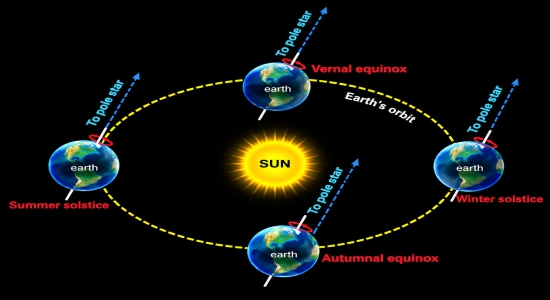
- Parallelism of the Axis : As Earth revolves around the Sun, its axis remains approximately parallel to itself, always pointing toward the same direction in space.
- Sphericity of the Earth : Because Earth is spherical, different places receive solar rays at different angles. More direct rays produce greater heating, while oblique rays produce less heating.
Position on 21st June- Summer Solstice
On June 21st, the Earth is in the summer solstice position, where the Northern Hemisphere tilts closest to the Sun.
- The Northern Hemisphere is tilted towards the Sun.
- Sun's vertical rays fall on the Tropic of Cancer (23 1⁄2° N).
- The Northern Hemisphere experiences summer.
- The Southern Hemisphere experiences winter.
- Longest day and shortest night occur in the Northern Hemisphere.
- Areas near the Arctic Circle experience 24 hours of continuous daylight.
Position on 22nd December- Winter Solstice
On 22nd December, the Earth is in the Winter Solstice position, where the South Pole tilts toward the Sun.
- The Northern Hemisphere is tilted away from the Sun.
- Sun's vertical rays fall on the Tropic of Capricorn (23 1⁄2° S).
- The Northern Hemisphere experiences winter.
- The Southern Hemisphere experiences summer.
- The Northern Hemisphere has its shortest day and longest night.
Positions on 21st March and 23rd September - Equinox
An equinox is an event when the Sun shines directly above the Earth's equator, making day and night nearly equal in length across the globe
- The Sun's vertical rays again fall on the Equator.
- Day and night are approximately equal.
- The Northern Hemisphere has spring on 21st March and autumn on 23rd September.
- Southern Hemisphere → autumn on 21st March and spring on 23rd September.
Solar Eclipse
A solar eclipse occurs when the Moon comes between the Sun and the Earth, and the Moon’s shadow falls on the Earth. It can occur only during a New Moon.
Why does a solar eclipse not occur every new moon day or every month?
A solar eclipse does not occur on all new moon days because the Moon doesn’t orbit in the same plane as the Sun and Earth. The Moon's orbital path is tilted by about 5 degrees relative to Earth's orbital plane around the Sun.
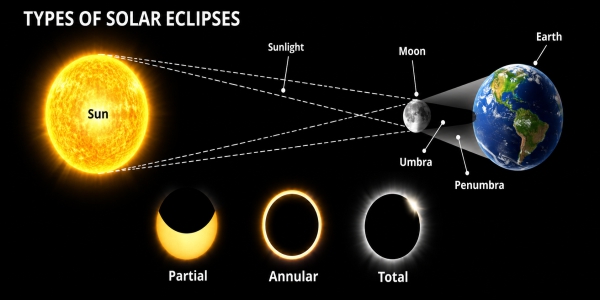
Types of Solar Eclipse:
Total Solar Eclipse
- The Moon completely covers the Sun's bright disc.
- Occurs when the Moon's umbra reaches Earth's surface.
- The solar corona becomes visible.
Partial Solar Eclipse :
- Only a part of the Sun is covered.
- The observer lies in the penumbra of the Moon's shadow.
Annular Solar Eclipse :
- The Moon comes directly in front of the Sun but appears slightly smaller.
- A bright “ring of fire” remains visible around the Moon.
- Occurs when the Moon is relatively farther from Earth, near apogee.
Umbra → central, darkest part of moon's shadow Penumbra → lighter outer part of the shadow |
Lunar Eclipse
The moon moves in an orbit around the Earth. At the same time, earth orbits the sun. Due to this movement, sometimes their paths at certain positions create a shadow of one over other thus creating an eclipse.
A lunar eclipse occurs when the Earth comes between the Sun and the Moon, and the Moon passes through the shadow cast by Earth. It can occur only during a Full Moon.
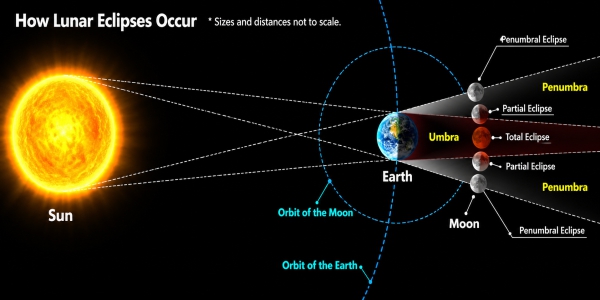
Types of Lunar Eclipse:
Total Lunar Eclipse:
- The entire Moon enters Earth's umbra.
- The Moon often appears reddish.
- The red colour results mainly from sunlight being refracted and filtered through Earth's atmosphere.
Partial Lunar Eclipse :
- Only a part of the Moon enters the umbra.
- The remaining part remains outside the umbra.
Penumbral lunar eclipse :
- The Moon passes only through Earth's penumbra.
- The change in brightness is subtle and can be difficult to notice.
Tides
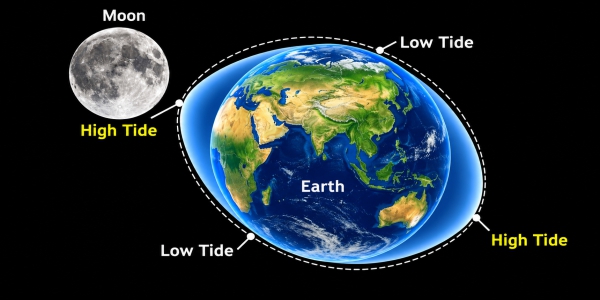
Tides are the periodic rise and fall of sea level caused primarily by the gravitational attraction of the Moon and the Sun, along with the centrifugal effect associated with the Earth–Moon system.
Major Causes of the Tides:
1. Gravitational pull of the moon and sun : Although the Sun is much larger, the moon has greater tidal pull, because it is much closer to Earth. The Moon's gravity pulls ocean water toward the Moon, producing a tidal bulge on the side facing the Moon.
The Sun also produces tides, but its tidal-generating force is weaker than the Moon's because of the large distance between them .
2. Centrifugal force : On the opposite side of the earth, the attractive force is less, as it is farther away from the moon, the centrifugal force is dominant. Hence, there is a net force away from the moon. It creates the second bulge away from the moon.
Types of Tides :
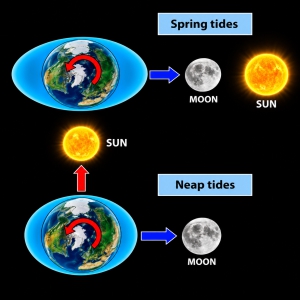
Spring tides occur around the New Moon and Full Moon, whereas neap tides occur around the First Quarter and Third Quarter Moon.
- Spring Tides : Spring tides occur when the Sun, Earth and Moon are approximately aligned. The gravitational effects of the Sun and Moon reinforce each other.
- Neap Tides : Neap tides occur when the Sun and Moon are approximately at right angles with respect to Earth. The gravitational effects partly counteract each other.
Other Factors Control the nature of Tides
The nature and magnitude of tides are controlled by a combination of astronomical gravitational forces and terrestrial geographic factors.
- Configuration of Oceans and Coastlines: Irregular coastlines, basin shapes, and large continents block or redirect the westward passage of tidal bulges as the Earth rotates.
- Continental Shelves: Wide continental shelves magnify the height of tidal bulges, whereas mid-oceanic islands experience much lower amplitudes.
- Bays and Estuaries: Funnel-shaped bays (such as the Bay of Fundy) drastically concentrate and increase the tidal range.
Importance of Tides
1. Navigation : High tides can increase water depth and facilitate entry of ships into shallow ports and estuaries.
Example : Hooghly River, West Bengal; High tides help maintain navigable depth.
2. Tidal Energy : The predictable rise and fall of tides can be used for renewable electricity generation.
Example : Gulf of Khambhat & Gulf of Kachchh has high tidal energy generation potential due to unique topography.
3. Fisheries : Tidal currents influence nutrient mixing, sediment transport and coastal ecosystems.
4. Coastal Geomorphology : tides facilitate Sediment transport, mudflat formation and estuarine development.
Example : Sundarbans, Regular tidal inundation creates the saline, waterlogged environment supporting mangrove ecosystems.
Thus, in many ways tides play an important role by contributing to vital economic, ecological and geological aspects.