UPSC Current Affairs
Pradhan Mantri Dhan Dhanya Krishi Yojana
In the Union Budget 2025-26, Finance Minister Nirmala Sitharaman introduced several significant measures to strengthen India's agricultural sector. These initiatives focus on improving productivity, sustainability, and the socio-economic well-being of farmers, especially in rural areas. ABOUT THE YOJANA Objective: The scheme aims to boost agricultural productivity, crop diversification, and the adoption of sustainable farming practices, specifically targeting areas with low agricultural output.
VRAuthor Desk
4 min read
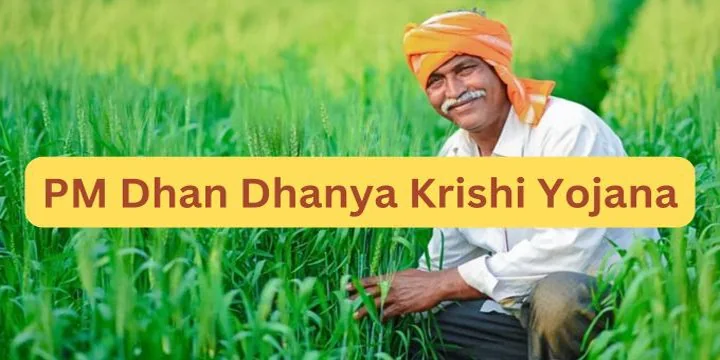
In the Union Budget 2025-26, Finance Minister Nirmala Sitharaman introduced several significant measures to strengthen India's agricultural sector. These initiatives focus on improving productivity, sustainability, and the socio-economic well-being of farmers, especially in rural areas. ABOUT THE YOJANA Objective: The scheme aims to boost agricultural productivity, crop diversification, and the adoption of sustainable farming practices, specifically targeting areas with low agricultural output.
- In the Union Budget 2025-26, Finance Minister Nirmala Sitharaman introduced several significant measures to strengthen India's agricultural sector.
- These initiatives focus on improving productivity, sustainability, and the socio-economic well-being of farmers, especially in rural areas.
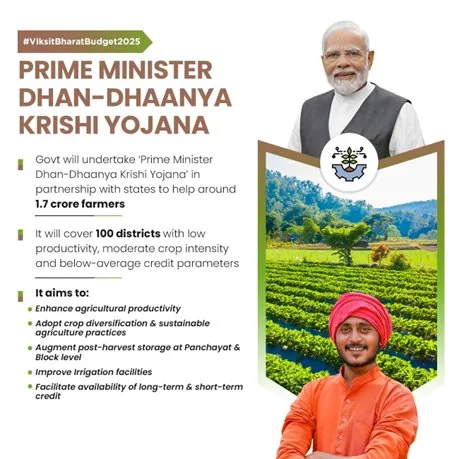
ABOUT THE YOJANA
- Objective: The scheme aims to boost agricultural productivity, crop diversification, and the adoption of sustainable farming practices, specifically targeting areas with low agricultural output.
- Focus Areas:
- Improvement in Post-Harvest Storage: Enhance storage infrastructure at the panchayat and block levels.
- Irrigation Facilities: Improved irrigation systems to ensure water availability during critical crop growth periods.
- Credit Support: Provision of both short-term and long-term credit to farmers.
- Target: The program is expected to impact around 7 crore farmers in 100 districts with low productivity, moderate crop intensity, and below-average credit scores.
- Partnerships: The initiative will be executed in collaboration with state governments and through the convergence of existing agricultural schemes.
FUNDING ALLOCATION
While no separate allocation was made for the scheme, funds have been earmarked for related missions such as:
-
- Rs 1,000 crore for the Mission for Pulses.
- Rs 500 crore for the Mission for Vegetables and Fruits.
- Rs 100 crore for the Makhana Board (to be set up in Bihar).
- Rs 100 crore for the Hybrid Seed Mission.
- Rs 500 crore for the Cotton Technology Mission.
SELF SUFFICIENCY MISSION FOR PULSES
- Focus: Achieve self-sufficiency in the production of tur (arhar), urad, and masoor (lentils).
- Details:
- Over the past decade, the government has already made progress towards self-sufficiency in pulses.
- The mission will ensure continued procurement by central agencies like NAFED and NCCF at minimum support prices (MSP).
- The government will enter into agreements with farmers, especially those in areas with surplus pulses, to procure the crop at remunerative prices.
NATIONAL MISSION ON HIGH YIELDING SEEDS
- Objective: Improve seed quality and yield by focusing on research and development in high-yielding, pest-resistant, and climate-resilient seed varieties.
- Scope: The mission will make more than 100 new seed varieties (developed since July 2024) commercially available to farmers.
MISSION FOR COTTON PRODUCTIVITY
- Purpose: Enhance cotton farming's productivity and sustainability, with a focus on extra-long staple cotton.
- Alignment with Textile Vision: The initiative is part of India's broader strategy to rejuvenate the textile sector, ensuring a steady supply of quality cotton for domestic production.
ENHANCED LOAN LIMIT FOR FARMERS
- New Loan Limit: The loan limit under the Modified Interest Subvention Scheme (MISS) has been raised from Rs 3 lakh to Rs 5 lakh.
- Impact: Farmers can now access credit more easily, with an interest rate subsidy, making loans more affordable and reducing financial stress during challenging seasons.
- The effective interest rate could be as low as 4% if farmers repay loans promptly.
- This will benefit small and marginal farmers, especially those with Kisan Credit Cards (KCC).
SELF SUFFICIENCY IN UREA FERTILIZER
- New Plant: To reduce dependency on imports, a new urea fertilizer plant will be set up in Namrup, Assam, with an annual capacity of 12.7 lakh metric tons.
- Goal: Achieve self-sufficiency in urea production to ensure the steady availability of fertilizers for farmers.
BUDGET ALLOCATION FOR AGRICULTURE:
- Total Allocation: Rs 1.37 lakh crore for the Ministry of Agriculture and Farmers' Welfare for 2025-26, a 4% increase from the previous year.
- Rs 1.27 lakh crore for the Department of Agriculture and Farmers' Welfare.
- Rs 10,466 crore for the Department of Agricultural Research and Education.
KEY SCHEME ALLOCATION
- PM-Kisan Scheme: Rs 63,500 crore (same as the revised estimates for FY 2024-25).
- Pradhan Mantri Fasal Bima Yojana (PMFBY): The budget allocation has been reduced to Rs 12,242 crore (down from Rs 14,600 crore last year), reflecting a shift in priorities.
CONCLUSION
The agricultural initiatives introduced in the Union Budget 2025-26 demonstrate the government's commitment to improving farmer welfare and transforming India's agriculture sector. By focusing on improving productivity, sustainability, and financial support, these measures aim to create long-term economic resilience in rural India. The increase in funding for critical sectors like pulses, seeds, cotton, and fertilizers, alongside the ambitious Prime Minister Dhan-Dhaanya Krishi Yojana, reflects a holistic approach to agricultural development.
- Prelims: Key facts, institutions, locations and terminology in the article.
- Mains: Connect the topic with Environment, Economy, International Relations.
- Revision: Use the article headings to prepare concise notes and answer-writing points.
Test your understanding
Questions from this article
Prelims practiceWith reference to Pradhan Mantri Dhan Dhanya Krishi Yojana, consider the following statements:
- In the Union Budget 2025-26, Finance Minister Nirmala Sitharaman introduced several significant measures to strengthen India's agricultural sector.
- These initiatives focus on improving productivity, sustainability, and the socio-economic well-being of farmers, especially in rural areas.
- Objective: The scheme aims to boost agricultural productivity, crop diversification, and the adoption of sustainable farming practices, specifically targeting areas with low agricultural output.
Which of the statements given above are correct?
- 1 and 2 only
- 2 and 3 only
- 1 and 3 only
- 1, 2 and 3
View answer
Answer: (d) 1, 2 and 3. All three statements are drawn from the article.
Mains practiceDiscuss the background, key issues and significance of Pradhan Mantri Dhan Dhanya Krishi Yojana for India.
Answer in 250 words.
View answer approach
- ABOUT THE YOJANA
- SELF SUFFICIENCY MISSION FOR PULSES
- NATIONAL MISSION ON HIGH YIELDING SEEDS
- MISSION FOR COTTON PRODUCTIVITY
- ENHANCED LOAN LIMIT FOR FARMERS
Frequently asked questionsFrequently asked questions
Why is Pradhan Mantri Dhan Dhanya Krishi Yojana in the news?
In the Union Budget 2025-26, Finance Minister Nirmala Sitharaman introduced several significant measures to strengthen India's agricultural sector. These initiatives focus on improving productivity, sustainability, and the socio-economic well-being of farmers, especially in rural areas.
What are the key facts about Pradhan Mantri Dhan Dhanya Krishi Yojana?
ABOUT THE YOJANA Objective: The scheme aims to boost agricultural productivity, crop diversification, and the adoption of sustainable farming practices, specifically targeting areas with low agricultural output. Focus Areas: Improvement in Post-Harvest Storage: Enhance storage infrastructure at the panchayat and block levels. Irrigation Facilities: Improved irrigation systems to ensure water availability during critical crop growth periods.
Why is Pradhan Mantri Dhan Dhanya Krishi Yojana important for UPSC preparation?
The topic connects current developments with Environment, Economy, International Relations and is relevant for both objective revision and analytical answer writing.