STATE OF THE CLIMATE REPORT BY WMO
The new
annual State of the Climate report, published on March 19, by the
World Meteorological Organisation (WMO) found that
2023 was the hottest year on record.
Numerous records for indicators of the
climate system, including greenhouse gas levels (GHGs), surface temperatures, ocean heat, sea level rise, Antarctic sea ice cover, glacier retreat, etc., were broken.
GREENHOUSE GASSES
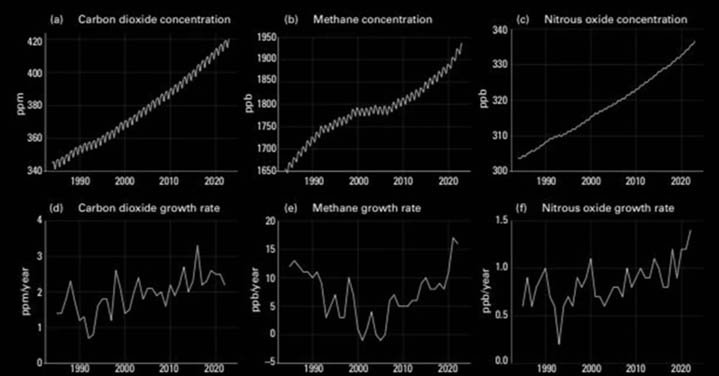
The unprecedented levels of GHGs in the atmosphere are the
main culprit behind the rapid warming of the planet. Gases such as
carbon dioxide, methane, and nitrous oxide trap the incoming solar radiation in the atmosphere and contribute to global warming.
 SURFACE TEMPERATURE
The
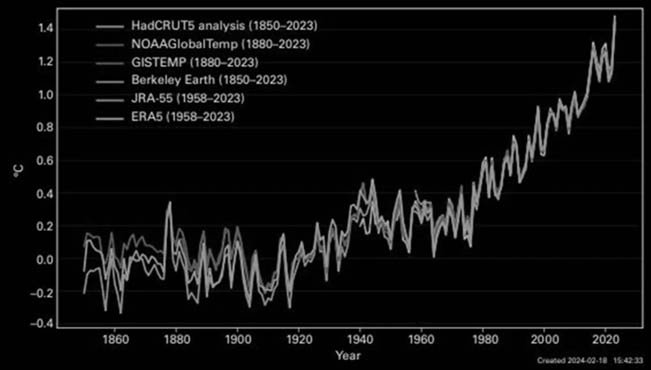
global average near surface temperature for
2023 spiked to
1.45 degree Celsius above the pre-industrial levels. Although the rise in GHG concentrations in the atmosphere is the primary reason for soaring global temperatures, the onset of
El Niño last year also contributed to the increase in mercury.
 OCEAN HEAT CONTENT
As the
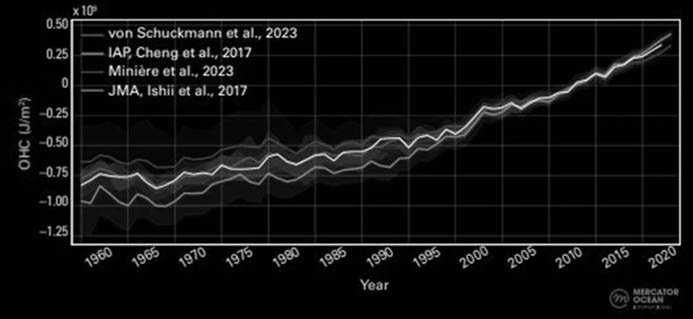
oceans have absorbed nearly
90 per cent of the extra heat trapped by GHGs since 1971, they steadily become warmer and their heat content has increased.
In 2023, the ocean heat content (OHC) — the total amount of heat stored by the oceans —
reached its highest level in the 65-year observational record, according to the report.
 MARINE HEATWAVES
Due to warmer temperatures, the global ocean
experienced an average daily marine heatwave (MHWs) coverage of 32%, well above the
previous record of 23% in 2016, the report added.
WHEN DO MARINE HEAT WAVES OCCUR?
MHWs occur
when the surface temperature of a particular region of the sea rises to 3 or 4 degree Celsius above the average temperature for at least five days.
ANTARCTIC ICE SHEET EXTENT
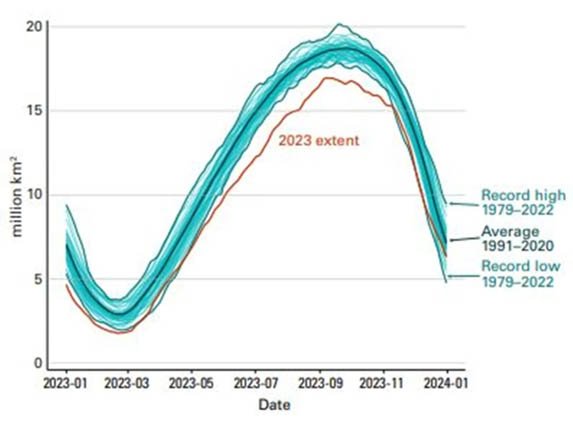
Antarctic sea-ice extent plummeted to 1.79 million km2 in February 2023 — a new record low since the satellite era began in 1979. The extent remained at a record low for the time of year from June till early November, according to the WMO report.
“the annual maximum in September was 16.96 million km2, roughly 1.5 million km2 below the 1991–2020 average and 1 million km2 below the previous record low maximum,” the report said.
 IMPACT ON GLACIERS
In the
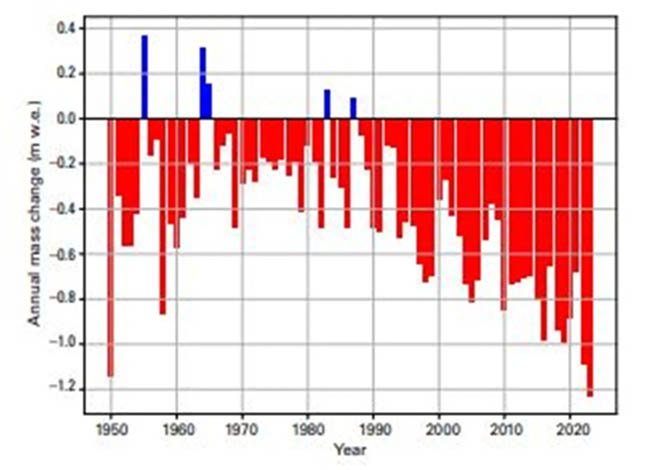
hydrological year 2022-2023, the global set of reference glaciers suffered the
largest loss of ice on record. Glaciers in
North America and Europe were particularly impacted.
According to the WMO report,
the annual mass balance —
the amount of mass gained or lost by the glacier and expressed in metres of water equivalent (m w.e.) — of the reference glaciers dropped to a new low in 2022-2023, which was
–1.2 m w.e.