GPS SPOOFING
Context
- On November 6, 2025, Delhi’s Indira Gandhi International (IGI) Airport experienced a rare and serious GPS spoofing incident — the first known case of its kind in India.
- The event disrupted several flight operations, caused delays and diversions, and led aviation authorities to issue alerts and advisories to all incoming flights.
- The episode has raised concerns about cybersecurity in aviation, particularly about how external electronic signals can interfere with aircraft navigation systems.
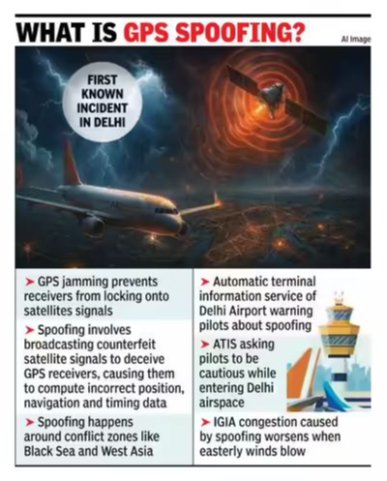 WHAT IS GPS SPOOFING?
- GPS spoofing is a cyber-attack where fake satellite signals are broadcast to deceive GPS receivers (in this case, aircraft navigation systems).
- These false signals mimic real satellite transmissions, leading the receiver to calculate incorrect position, altitude, or timing data.
In simple terms:
The aircraft “thinks” it’s somewhere else in the sky than it actually is.
HOW DOES GPS SPOOFING WORK?
- Attackers generate artificial GPS signals that imitate real satellite data.
- The aircraft’s GPS receiver picks up these stronger fake signals instead of authentic ones.
- The onboard navigation system then shows incorrect coordinates — misleading pilots about their real location or height.
- This can cause confusion during landing, take-off, or route navigation.
- In aviation, such false readings can be highly dangerous, especially during low-visibility landings that rely on precise GPS guidance.
AREAS WHERE SPOOFING IS COMMON
GPS spoofing has been increasingly reported in:
- Conflict zones – like Ukraine, the Black Sea, and Syria.
- West Asia and the Middle East – where electronic warfare systems are used to jam or mislead GPS signals.
- Military operation areas – to protect assets or mislead adversaries.
The Delhi incident is unusual because it happened in a
civilian, non-conflict zone, far from any active military theatre.
WHAT HAPPENED AT IGI AIRPORT?
The Technical Disruption
- The spoofed signals affected the Required Navigation Performance (RNP) — a GPS-based landing system used by aircraft for precision approaches.
- Flights approaching Runway 10/28 (one of Delhi’s busiest runways) reported incorrect position data on their navigation screens.
- Pilots received false altitude and location readings, which made GPS-guided landing impossible.
- As a result, flights had to switch to ground-based navigation systems like:
- ILS (Instrument Landing System)
- VOR (VHF Omnidirectional Range)
- Visual landing approaches
OPERATIONAL IMPACT
- Several flights (including Air India and Vistara) were diverted to alternate airports.
- ATIS (Airport Terminal Information Service) broadcast warnings advising pilots to avoid GPS-based landings.
- Air traffic congestion increased, especially during east wind conditions, when certain runways are more dependent on GPS-based navigation.
- The incident led to temporary delays and re-routing, though safety was not compromised.
AIRPORT & REGULATORY RESPONSE
The
Delhi International Airport Ltd (DIAL) and
Directorate General of Civil Aviation (DGCA) initiated prompt measures:
Immediate Steps Taken:
- Issued cautionary alerts through ATIS to all aircraft entering Delhi airspace.
- Suspended RNP-based landings
- Accelerated installation of a new ILS (Instrument Landing System) on Runway 10/28 — scheduled to be operational by November 27, 2025.
- Conducted test flights (by IndiGo) to validate new lighting and approach systems.
Investigation:
- DGCA and aviation cybersecurity teams are examining whether the spoofing signals originated from external sources — possibly drifting from West Asia, where active electronic jamming is ongoing.
WHY IS GPS SPOOFING DANGEROUS?
- Navigation Errors: Aircraft may believe they are off-course and make incorrect course corrections.
- Altitude Errors: False readings can mislead pilots during approach and descent, increasing accident risk.
- Autopilot Malfunction: Incorrect coordinates can disrupt autopilot and collision-avoidance systems.
- Air Traffic Management Issues: Miscommunication between aircraft and ATC (Air Traffic Control) due to conflicting data.
- Potential Loss of Control: In extreme cases, over reliance on spoofed GPS data could cause serious safety threats.
Fortunately,
Indian pilots are trained to detect such inconsistencies and
switch to ground-based aids like ILS and VOR when GPS signals appear unreliable.
POSSIBLE ORIGIN OF SPOOFING SIGNALS
Experts suspect that:
- Electronic warfare operations in West Asia (for example, in and around Israel, Syria, and Iran) are jamming and spoofing GPS to protect sensitive zones.
- Under specific atmospheric conditions, such signals can travel long distances — even up to 2,000–2,500 km — and unintentionally affect civilian airspace in other countries, including India.
- Similar GPS disruptions have been previously observed affecting flights over Turkey and the Mediterranean.
ONGOING INVESTIGATION & POLICY IMPLICATIONS
Indian aviation authorities are:
- Enhancing monitoring of satellite navigation signals across major airports.
- Planning training and simulation modules for pilots to handle GPS spoofing scenarios.
- Coordinating with international aviation bodies (ICAO, IATA) for better cybersecurity protocols in aviation.
- Upgrading landing systems to hybrid models that can operate both with GPS and traditional ground-based guidance.
This event highlights how
electronic warfare in distant regions can have
unintended spillover effects on civilian aviation, even in peaceful areas.
BROADER SIGNIFICANCE
- Marks a new kind of aviation risk — not mechanical or weather-related, but digital and cyber-based.
- Highlights the growing importance of cybersecurity in civil aviation.
- Underlines the need for redundant navigation systems (both satellite and ground-based).
- Encourages India to strengthen electronic intelligence and spectrum monitoring around its major airports.
Note: Connect with Vajirao & Reddy Institute to keep yourself updated with latest UPSC Current Affairs in English.
Note: We upload Current Affairs Except Sunday.