AI & INDIA’S AADHAR UPI MODEL
Context
India has successfully built digital public infrastructure (DPI) such as
Aadhaar and
UPI, enabling secure identity and payments for over a billion people. With AI reshaping global economies, India now aims to build an
AI ecosystem rooted in Indian laws, green computing, and citizen-centric digital systems. This moment is seen as a potential
leapfrog opportunity similar to how India jumped from no landline network to mass mobile connectivity.
WHAT IS INDIA’S AI OPPORTUNITY?
- AI will transform how people learn, work, access services, and make decisions. But it can also disrupt India’s strengths, especially IT and back-office work, where automation may reduce certain roles.
- India can convert this challenge into an opportunity because:
- It already has identity (Aadhaar) and payments (UPI) infrastructure at scale.
- It has large datasets, growing internet access, and a young, tech-savvy population.
- It aims to combine AI + renewable energy to build a sustainable, globally competitive AI ecosystem.
- India can build an AI system similar to its DPI model: inclusive, affordable, lawful, secure, and built for India’s needs.
WHY INDIA NEEDS ITS OWN AI FRAMEWORK?
Three concerns make domestic AI capability essential:
- Digital Sovereignty: If powerful AI systems operate from abroad, India loses control over:
- Data usage
- Algorithmic decisions
- Bias and accountability
- Security risks
- National Security: AI will increasingly run:
- Public infrastructure
- Administrative systems
- Defence, energy, and financial services
- Foreign-controlled AI creates vulnerabilities.
- Economic Competitiveness: India must avoid depending on foreign AI in the same way it depends on foreign hardware manufacturing. Building domestic AI ensures high-value jobs, nt just low-value back-office tasks.
HOW INDIA CAN BUILD ITS AI FUTURE?
- AI Must Operate Under Indian Law and Jurisdiction
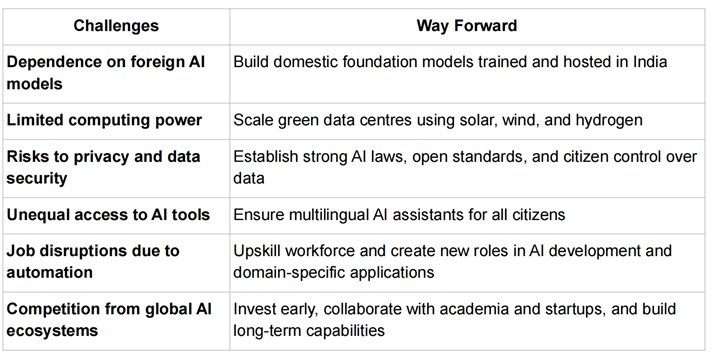
- Foundation models (large AI systems) must be trained, hosted, and regulated in India.
- India must chart its own path - not the corporate-led American model or the State-controlled Chinese model.
- Domestic AI ensures:
- Data stays in India
- Accountability to Indian users
- Transparent and secure AI operations
- Just as Aadhaar and UPI were designed for Indian needs, India now needs its own AI intelligence layer.
- Build a Green, Low-Carbon AI Infrastructure
- AI requires massive computing power - currently concentrated mostly in the US and China.
- India must quickly expand its capacity by building green data centres powered by:
- Solar and wind energy
- Green hydrogen
- Energy-efficient cooling systems
- Next-generation semiconductors and power electronics
- This becomes a green industrial opportunity, stimulating investment in:
- Renewable energy
- Data-centre technology
- AI hardware ecosystems
- India can leap directly to a green frontier, where economic growth and sustainability go together.
- Every Indian Should Have a Multilingual Personal AI Agent
- India’s future AI ecosystem should give every citizen a secure, private, multilingual AI assistant that they control.
- Examples:
-
- A farmer receives weather, pest, and crop advice in his local language.
- A student uses AI for language learning and revision support.
- A patient manages medical records and receives health guidance.
- Key features:
- Secure data storage
- User control over information
- Privacy and transparency
- Open standards for interoperability
- This mirrors Aadhaar-UPI principles: inclusion, accessibility, trust, and scale.
IMPLICATIONS
- New economic opportunities in data infrastructure, model development, and AI-powered services.
- Potential job shifts in IT and back-office sectors due to automation.
- Enhanced national security through domestic AI governance.
- Green economic growth driven by renewable-energy-powered AI.
- Stronger global competitiveness, similar to how India built leadership in digital payments.
 Note: Connect with Vajirao & Reddy Institute to keep yourself updated with latest UPSC Current Affairs in English.
Note: We upload Current Affairs Except Sunday.
Note: Connect with Vajirao & Reddy Institute to keep yourself updated with latest UPSC Current Affairs in English.
Note: We upload Current Affairs Except Sunday.